
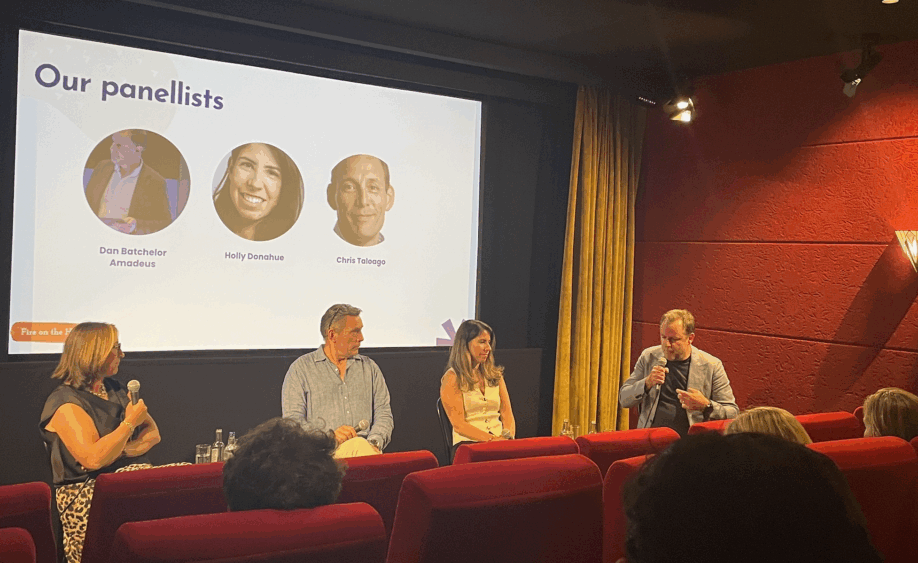
Last week, I went along to an event hosted by comms agency Fire on the Hill, where the company unveiled the findings of its latest study, The Voice of the Chief Communications Officer, involving the views of 200+ comms leaders in the UK and US.
The findings were then discussed by a panel including:
- Daniel Batchelor, SVP, Global Corporate Marketing and Communications, Amadeus
- Holly Donahue, Director of Communications, Institute for Law and AI
- Chris Talago, Head of Corporate Affairs and Communications, Pure Data Centres Group
Here are some key highlights and my own viewpoints:
Top-line summary: The role of comms is gaining relevance and influence
Fire on the Hill co-founder Chris Clarke outlined four key themes emerging from the study:
1) The rising influence of comms leaders
Communications professionals have long complained that they have not been represented at board level, but at a time of volatile markets and when trust in media, government and brands is low, the skills and experience of communications professionals are becoming more valued.
More than a third (36%) say comms leaders’ influence has risen significantly in the past year, while 39% said it has increased ‘somewhat’. Overall, 77% said that comms has always had some role at the top level. Significantly, in the UK, one in five (20%) survey respondents said that comms is now represented at the highest level of the business, where this hasn’t always been the case over the last five years, while 15% of US respondents said the same.
“Comms is stepping into the spotlight. Often comms doesn’t have a seat at the top table, but this is changing,” Clarke said. Comms is now involved in a senior advisory role around areas as diverse as policy, regulation, sustainability and Diversity, Equity and Inclusion (DEI).
Amadeus’s Dan Batchelor added that at times of uncertainty “you’re more likely to buy good advice”. Historically, comms has valued itself on its productivity, said, but Covid and recent geopolitical events have meant people are far more concerned now with the optics. Batchelor argued that the lawyers used to have the leadership’s ear, but that comms’ perspective is now increasingly valued.
My take: I’ve heard comms referred to as the ‘colouring-in department’ by the C-suite in the past; it’s not always been taken as seriously as it should, but it’s great to see its role rising. You can often spot when a comms person hasn’t been in the room when a strategic decision is made, as the result often blows up in a brand’s face. Trust is going to be key for all brands and comms pros are there to think two, three, four steps ahead on how the media and consumers alike with perceive and respond.
2) Tools and approaches of industry are evolving
The study finds that Artificial Intelligence (AI) and automation is the most important issue (24%) overall for organisations, followed by economic uncertainty (14%). AI is driving change in terms of tools and approaches, Clarke said, with concerns around mis/disinformation, the commoditisation of content, and ethics being key concerns.
They are also an opportunity for comms, as AI enables consultants to take on an advisory role. He argues we should see AI as a “partner, not a tool”. In the panel discussion, Holly Donahue argued that the chief communications officer is only going to get more important in the era of AI.
My take: I agree that comms has a massive role to play in the integration of AI into the business, especially when it comes to the real or perceived impact on human jobs (as language learning service Duolingo found out to its cost recently).
When it comes to using AI to be more productive and creative, I was surprised to learn that just over a quarter (27%) of comms leaders surveyed said that AI is ‘fully integrated into workflows’. I’d expect most if not all companies to be using some AI regularly as standard, whether for data analysis, ideation, conceptualisation, note-taking and content summarisation, for example.
I am very against using generative AI to create content intended for publication (see my past rants on this) for authenticity and copyright reasons, but I’d be keen to know more about the context of where AI is being integrated.
Nearly one in three (28%) are ‘piloting tools,’ while a further third (32%) are ‘exploring use cases’. Just 12% of respondents are not currently using AI or automation in communications, Fire on the Hill finds.
3) Channels to market are evolving
Digital remains the most important channel to market (20%), while it is worth noting the rise of ‘newsfluencers’ as a target market. Given large language models (LLMs) are learning from reputable news sources, PR-driven content is going to be critical to informing those models and thus influencing the results that are presented back to users.
My take: Informing/educating LLMs is going to be a key focus for comms professionals in the coming years. We used to say that content and PR had two audiences – people and search engines, but we can add a third in LLMs now, and that presents a new challenge to PR and content leads.
4) Progress on priorities is not always linear
The way we talk about things like sustainability is improving, Clarke said, while, conversely, DEI is in flux due mainly to policies in the US. Some firms are cancelling DEI altogether, while many others no longer see it as a priority. Clarke argued that organisations must live up to their promises, and the overwhelming majority of comms pros (96%) agree that their role is to be the ‘guardian of purpose and values’.
My take: Sustainability and DEI have long been wedge issues for those on the right of the political spectrum. At the moment, in much of the world – most notably and vocally in the US – they feel they are in the ascendency. But however loud those voices, they won’t change the fact that there are benefits to people, the planet, and the business by acting sustainably and with compassion for people from all backgrounds.
Comms budgets are on the rise
Finally, some good news for the comms sector, as 80% of in-house comms professionals expect to see budgets rising, with one in 12 (eight per cent) anticipating growth of 50% or more. It’s been a really uncertain couple of years for the comms industry, so any sign of green shoots is welcome.
As I mentioned in a recent post, I reckon about 80% of the work I have pitched for in the last 12 months has either disappeared altogether or been delayed.
However, I echo Chris Talago’s point in the panel discussion when he questioned where that budget was going. The study doesn’t go into specifics.
In conclusion
Summing up, it’s great to see that the reach of comms is extending across the organisation. Siloes have often been a big challenge for us as we seek to influence decisions or gain access to salespeople for customer data and case studies etc. So to see comms rise in influence is very welcome indeed.
I did expect to see more progress on AI, but then – as with social media adoption back when it was emerging – many organisations move at a glacial pace, sometimes to their cost.
Many thanks again to Fire on the Hill for inviting me along to what was a really interesting evening. Once again, you can find the study here on their website.
*This post first appeared on LinkedIn.
