

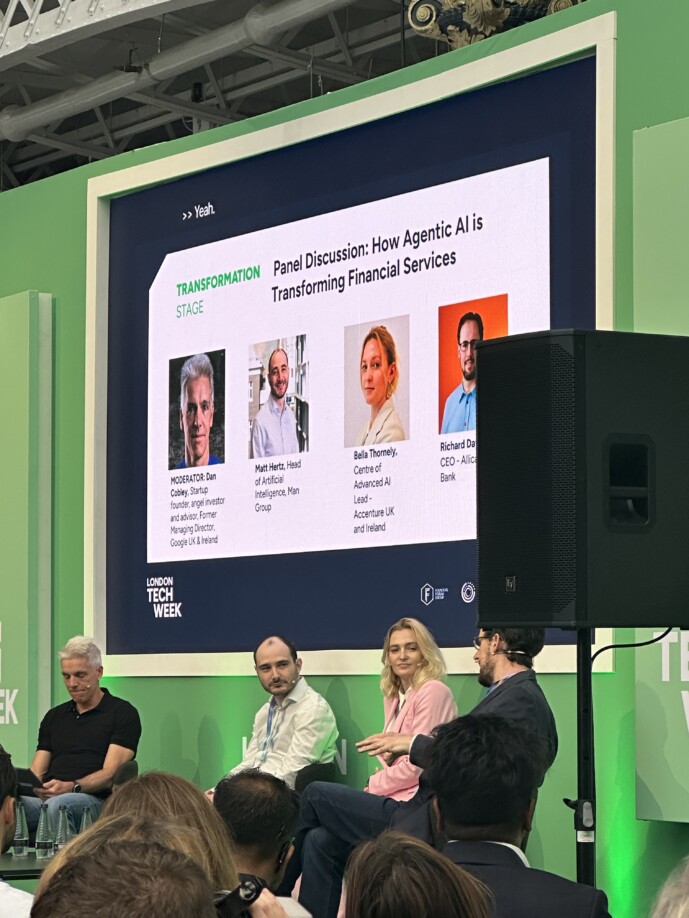
I went to London Tech Week 2026, and I was impressed by the buzz; there was a real, tangible and positive energy that I’ve not felt in a while. I spent a morning at the Transformation Stage listening to luminaries from the financial services sector discuss AI in finance.
Here are some observations and takeaways for financial sector communicators.
The value question hasn’t been answered yet
Despite the hype, according to the panels I listen to, it appears most financial institutions are still struggling to extract real returns from AI. One estimate from a major consultancy put the proportion of firms genuinely seeing value at just one in ten. Why? Many organisations treated AI as a technology problem rather than a business model question.
More than once, speakers used the analogy of an iceberg. Firms are so focused on the visible part that they often overlook what’s under the waterline, like the operating model, data strategy, and governance frameworks. The general consensus seemed to be to start with the outcome you want, not the technology you want to use.
Token costs are the new budget headache
A recurring practical concern was token inflation, the rising cost of running AI at scale. The question being asked internally is at what point does it make more sense to hire more people than burn through more tokens? Some banks have token deals with the big AI companies, but it’s still a cost-versus-return consideration.
Teams are having to prioritise where AI genuinely adds value. We’re still at the foothills of this technology, so it will be interesting to see how this influences decision-making.
Build or buy is the perennial question
There was a clear lean towards building in-house, particularly where data is the differentiator. The logic being that if your competitive advantage sits in proprietary data, you don’t want to hand it to a vendor.
That said, the consensus was less about build-versus-buy and more about staying modular. Lock yourself into a five-year contract, and you could be left behind as the tech changes so quickly.
“If you’re going to buy, you need to be agile,” was one of the more quotable lines of the day.
AI as both an “antidote and poison” in modern fraud
The fraud session was blunt. Fraudsters are already using AI to attack at scale, and the industry is in a reactive position. One bank shared a specific example of a tool that flagged when a customer was simultaneously on a call and using the app, which cut bank impersonation scams significantly. Simple idea, serious result.
The broader frustration centred on liability. With over £1 billion in annual fraud losses across the sector in the UK per year, placing all responsibility on financial service providers is hampering innovation and redirecting capital that could go into prevention.
Regulation is less of a blocker than expected
There was cautious optimism around regulators. The Financial Conduct Authority (FCA) was specifically called out as more encouraging of AI adoption than many of its international counterparts. The US was cited as a reference point for governance frameworks, particularly around predictive AI.
So, regulators are also finding their way, but they’re not standing in the way. Financial institutions must build governance models that enable innovation without losing control, and even as agentic systems advance, humans must always be in the loop.
What the autonomous bank actually means
The “path to a fully autonomous bank” framing generated the most debate. The honest answer from practitioners is that it doesn’t exist yet, and anyone claiming otherwise is ahead of the evidence.
The more useful framing was around what autonomy means at different levels:
- Customer-facing: Personalised, bespoke experiences replace traditional, linear workflows
- Internal operations: Agentic AI handling compliance prep, AML anomaly detection, and communications surveillance
- Workforce: Not fewer people, but humans bring critical thinking, judgment, and communications skills
According to Deloitte research cited on the day, only 11% of customers, according to Deloitte research, want to make a complaint to a machine, so the human element isn’t going away.
The bottom line
I got the impression that the financial sector sees AI as an enabler, not a standalone strategy. The most advanced firms are the ones with a clear business outcome in mind. They have built strong data foundations and keep a human in the loop for key judgement calls.
My takeaway for communicators: As your institution unrolls its adoption of AI throughout the business, you will need to be able to communicate to customers and the market what your goals are and where AI is involved in their interactions with the bank. How will it benefit them? Is their data secure? These are things that matter to consumers and different demographics will have different expectations.
If you work in financial services and need any help with your content to tell your AI transition story, please contact us.

![BrightonSEO deckchair [Photo: Chris Lee/Eight Moon Media]](https://eightmoon.co.uk/wp-content/uploads/2025/10/Screenshot-2025-10-27-at-08.53.03-1-768x678.png)